
The short answer
A texture-painting price per square metre is not enough to select a quotation. First agree the pattern, colour, material system, wall preparation, measured areas, access and finish acceptance through a physical sample. For a Bali villa, home, restaurant or commercial space, an approved sample record connects the intended appearance to the work actually being priced.
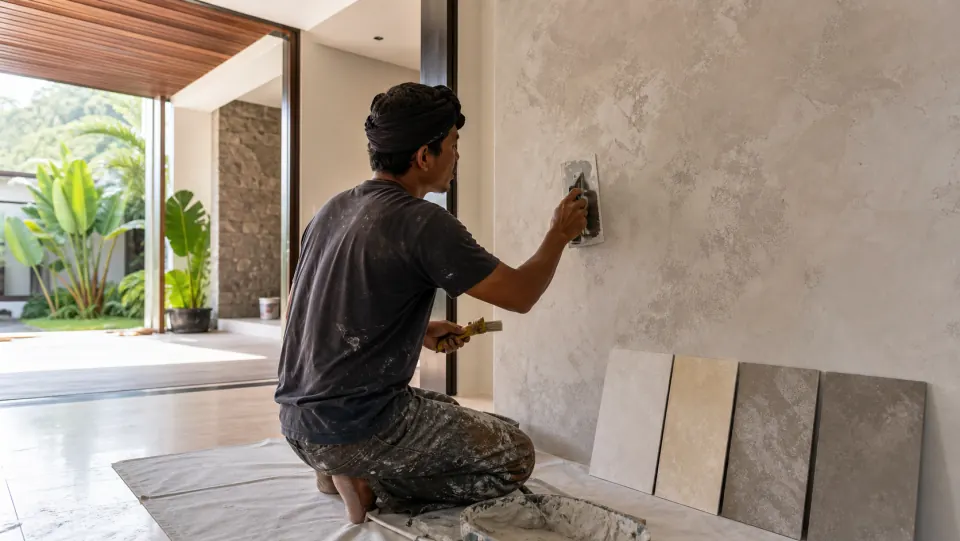
1. Identify each surface and its intended use
Name each surface: bedroom feature wall, front façade, corridor or stairwell. Provide overall and close-up photographs, dimensions, height, and whether it is indoors or outdoors. Explain whether this is new work, an existing coating to be covered or an existing texture to be repaired. This is more useful than sending one reference image without showing the actual site.
Mark visible dampness, cracking, peeling and uneven areas so inspection and repair requirements can be considered. A textured finish is not a reason to skip checking the underlying wall. For Bali projects with narrow access, occupied rooms or high façades, record working routes and operating-hour restrictions in the initial enquiry. This helps bidders price the same working conditions.
2. Choose an appearance before locking in a product
Describe the intended appearance separately from a product name: fine grain, roller pattern, trowel marks or another effect. Share two or three references and identify what you like, such as pattern scale or sheen. Screens and photographs help communication, but final approval should use actual materials under lighting representative of the intended location.
Leganza’s official Decorative Texture page shows different patterns by product and tool, including spray, roller and trowel finishes. Propan’s DTX-250 technical sheet requires a dry, clean, sound surface and explains that drying depends on texture size, temperature and humidity. These statements apply to the referenced products. Check the selected system’s own current instructions rather than carrying specifications across to another product.
3. Make the approved sample usable on site
Request a sample representative enough to show pattern repetition and the way surfaces meet. Agree its size and cost first: several design alternatives are not automatically included in the production price. Once a small board is acceptable, decide whether an on-wall trial is needed before the complete area proceeds. Keep an approved physical reference until handover so later decisions do not rely on memory or photographs alone.
| Sample record | What to record | How it helps production |
|---|---|---|
| Identification | Sample code, location, date and approving person | Prevents an outdated reference being used |
| Material system | Product names, colour code, layer sequence and technical reference | Connects the quotation to agreed materials |
| Appearance | Pattern, movement direction, texture scale and sheen | Provides a shared visual inspection reference |
| Viewing conditions | Agreed lighting, position and assessment distance | Reduces disagreement at handover |
| Rectification | Panel boundaries and the touch-up trial procedure | Clarifies how an unacceptable area will be addressed |
4. Compare quotation scope as well as the unit rate
Ask for surface preparation, identified repairs, primers or base coats, texture and finishing coats to be described for the proposed system. Establish who supplies materials, tools, scaffolding, transport, glass and floor protection, cleaning and waste removal. A labour-only quotation and a labour-and-material package should be compared only after those responsibilities have been aligned.
For a measurement example, a wall measuring 4 × 3 metres has a gross area of 12 m². If the agreed opening deduction is 2 m², the example’s net area is 10 m². Window reveals, beams, columns and small areas may be measured separately under agreed rules. These figures illustrate quantity administration; they are not BPP project quantities or a Bali market price calculation.
5. Agree panel boundaries, sequencing and decision dates
Mark corners, opening edges, colour changes and planned stopping points on photographs or drawings. Ask the applicator to explain sequencing and access requirements before the programme is accepted. Do not assume adjacent surfaces can always be completed separately without affecting their appearance. Discuss the approved sample together with the proposed panel arrangement and record the agreed approach.
Identify who can approve the sample and subsequent colour changes. Set decision dates so the team does not start production against a provisional reference. For exterior work, discuss adjustments for actual site conditions and the product’s application instructions. For occupied rooms, agree furniture movement, protection, restricted access and the conditions for returning each area to use.
6. Define acceptance and prepare your BPP enquiry
Inspect against the approved sample and identify the location of each concern rather than simply requesting a 'more even' finish. Agree acceptable pattern variation, edges requiring correction, cleanliness and the rectification trial procedure. If a local patch is visually unacceptable, discuss the proposed full-panel repair boundary before additional work is carried out or charged. Record the decision with the responsible person.
For texture painting in Bali, send BPP the location, surface photographs, approximate dimensions, existing condition, appearance references and preferred dates. Specify labour only or labour and materials so responsibilities can be stated clearly in the quotation. The final price follows the agreed scope, selected system and assessed conditions. Sample work, access provisions and identified repairs should each be explained openly.
What to send for a quotation
- Bali location, overall and close-up photographs, dimensions, height and existing coating condition.
- Appearance references, proposed products and an approved physical sample record.
- Area measurement rules, opening deductions and treatment of reveals and details.
- Responsibilities for preparation, repairs, materials, equipment, access, protection and cleaning.
- Named approver, panel boundaries, finish criteria and variation and touch-up procedures.
Questions before work starts
- Are sample-making and sample-revision costs clearly explained?
- Do all quotations use the same material system, measurement rules and responsibilities?
- Who approves the finish, and what is the procedure if a touch-up looks different?
Related guides
Product references
These are examples of manufacturer documentation. Use the documents for the products and system actually selected for the project.